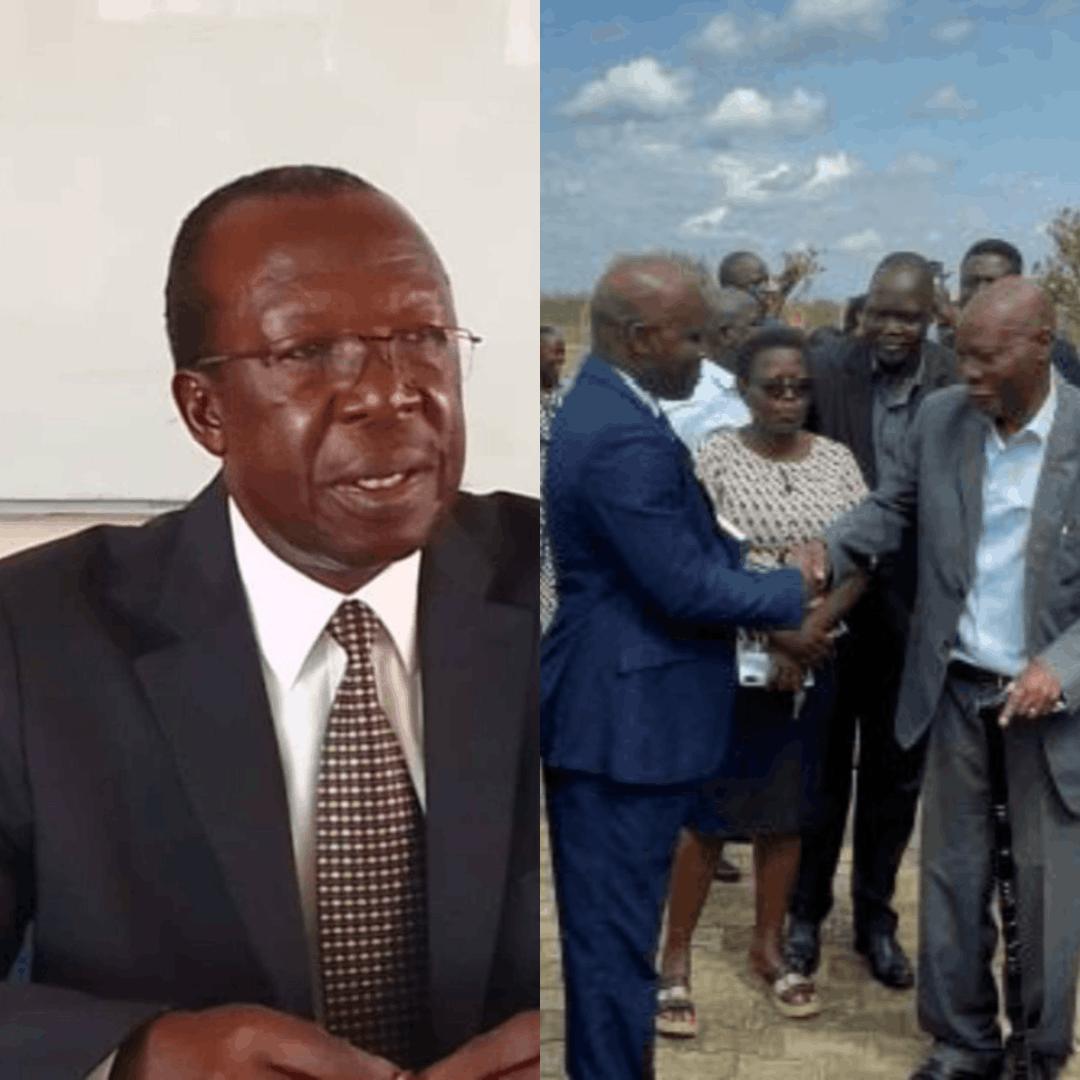

Lira, Uganda – The leadership crisis at Lira University has escalated dramatically, with Vice Chancellor Professor Jasper Watson Ogwal Okeng rejecting a formal notice to show cause issued by the University Council and accusing Council Chairperson David Opiokello of exceeding his statutory mandate .
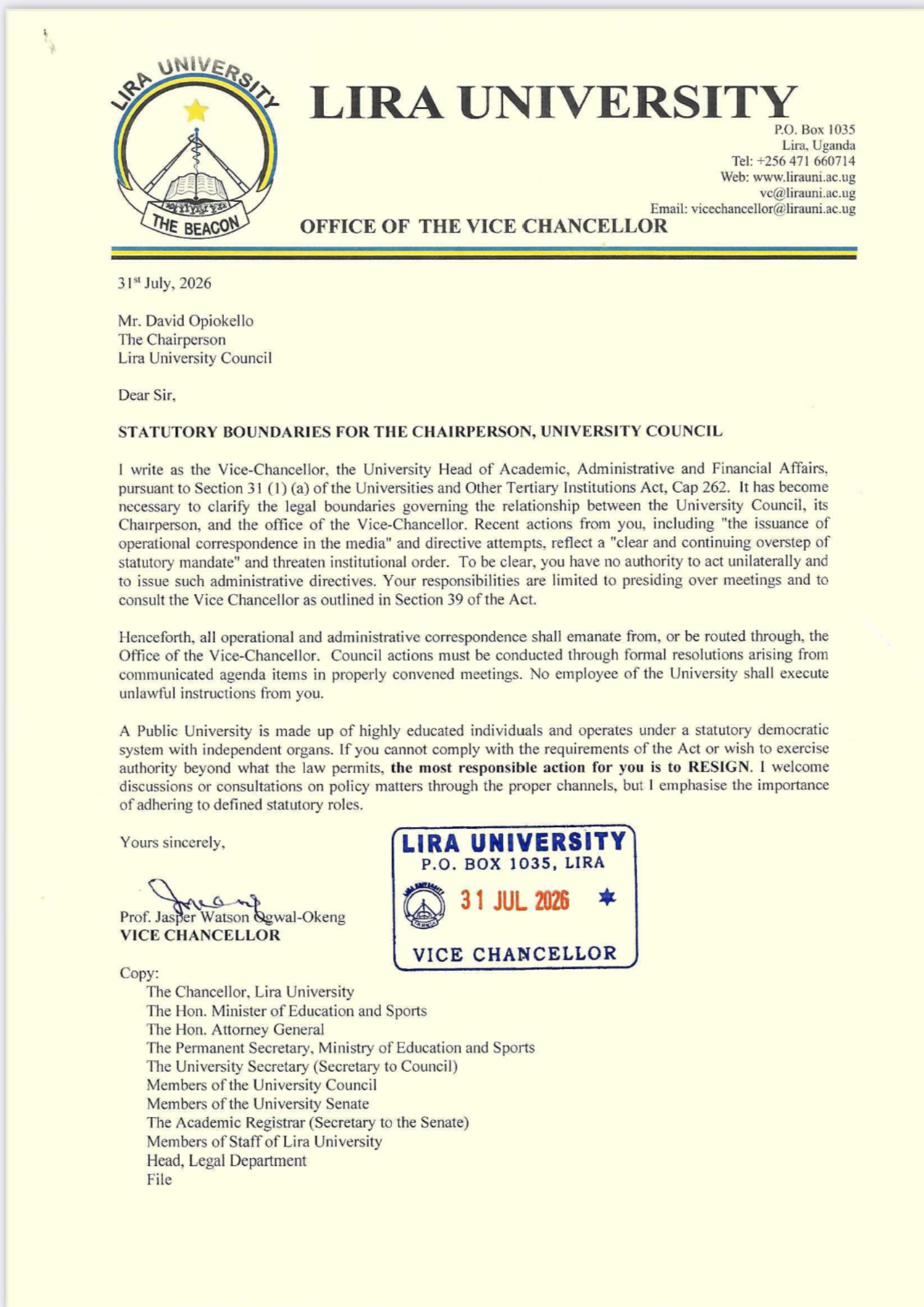
In a strongly worded response dated July 31, 2026, Prof. Ogwal Okeng asserted that the Chairperson "has no authority to act unilaterally" and that his responsibilities are "limited to presiding over meetings" under Section 39 of the Universities and Other Tertiary Institutions Act .
"If you cannot comply with the requirements of the Act or wish to exercise authority beyond what the law permits, the most responsible action for you is to RESIGN," the Vice Chancellor wrote, in what observers describe as an unprecedented challenge to the Council's authority.
The confrontation follows a formal "Notice to Show Cause" issued by Opiokello on July 27, 2026, requesting the Vice Chancellor to clarify several administrative actions taken following his unannounced return from sick leave on July 13, 2026 .
The Council's letter raised concerns that Prof. Ogwal Okeng resumed duty three days earlier than the previously communicated date of July 16, 2026, without formally notifying the Council or the Chancellor . The Council demanded clarification on the withdrawal of the Deputy Vice Chancellor's official vehicle, security detail, and salary—actions taken following the Vice Chancellor's return, which the Council contends contravened its subsisting resolutions extending the DVC's contract .
However, in his response, Prof. Ogwal Okeng asserted that the Chairperson had overstepped his authority, declaring that "all operational and administrative correspondence shall emanate from, or be routed through, the Office of the Vice-Chancellor."
The Vice Chancellor further stated that "no employee of the University shall execute unlawful instructions" from the Chairperson and that "Council actions must be conducted through formal resolutions arising from communicated agenda items in properly convened meetings."
A staff member, speaking anonymously, described the situation as "unprecedented" and "deeply worrying for the future of the university."
The crisis at Uganda's youngest public university has drawn the attention of national authorities. The Attorney General's recent legal opinion, sought by the Vice Chancellor himself, concluded that Deputy Vice Chancellor (Academic Affairs) Assoc. Prof. Okaka Opio Dokotum had already exhausted the two five-year terms permitted under the law and was therefore ineligible to continue occupying the office .
The Chancellor, Justice Dr. Benjamin Odoki, has been copied on all correspondence, along with the Minister of Education and Sports and the Attorney General.
The university, which celebrated its 10th anniversary in 2025, is set for a crucial graduation ceremony, and stakeholders fear the ongoing governance dispute could overshadow the institution's achievements .
Efforts to reach Mr. Opiokello for comment were unsuccessful by press time.
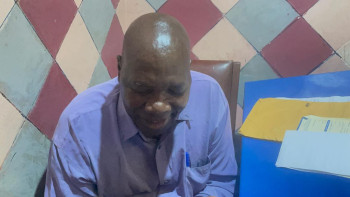
The university is a highly structured institution governed by specific management procedures that distinguish it from primary and secondary schools. At the operational level, the Vice-Chancellor and University Secretary oversee day-to-day administration, while the Senate holds authority over academic programs, curriculum development, and the evaluation of candidates for degrees and awards. Meanwhile, the University Council serves as the supreme policy-making body, responsible for approving regulations, acknowledging institutional laws, and ensuring overall governance—though, according to some sources, the Chairperson of Council often occupies a largely ceremonial role. The Council also consolidates reports from various committees into comprehensive activity summaries that guide institutional decision-making. As Ogwal Okeng recently remarked upon returning to his office, the university is not run like a primary or secondary school—its layered hierarchy, shared governance, and statutory mandates reflect a complex institution designed for higher learning and research.