LIRA / KAMPALA – What began as a weekend of political reflection in Lira City has turned into a moment of national mourning, after Ambassador Dickson Ogwang-Okul learned of the brutal killing of author Joe Nam just hours after meeting President Yoweri Museveni to discuss Uganda’s political future.
In a deeply moving eulogistic statement released Monday, Ogwang-Okul described Nam’s death as a profound national loss, made all the more poignant by the subject of the late author’s work, The Day Museveni Goes.
“In that moment, his book ceased to be just a political commentary. It became a final testament,” the ambassador wrote.
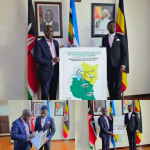
Ogwang-Okul had met President Museveni on Saturday, the 18th, in Lira City—an encounter he characterized as “a moment of reflection on a journey that has defined our nation.” By Sunday morning, however, news broke that Nam had died violently under circumstances that remain unclear. The ambassador confirmed the killing as sudden and brutal, though official details are still sparse.
In his statement, Ogwang-Okul framed his own work, Uganda Since 1986, and Nam’s as two sides of a critical national conversation.
“Uganda Since 1986 is a tribute to the transformation under President Museveni’s visionary leadership—from instability to relative peace, from institutional collapse to state rebuilding,” he explained. “Joe Nam’s work, on the other hand, is anchored on a central question: what happens when President Museveni eventually leaves office?”
The ambassador was explicit in affirming his ideological stance. A firm believer in the National Resistance Movement (NRM) and a loyal supporter of President Museveni, Ogwang-Okul emphasized that while Nam’s book raises questions worth reflection, he disagrees with many of its conclusions, describing aspects of it as ideologically contrary to the NRM and the President’s legacy.
Nevertheless, he underscored the importance of engaging with dissenting perspectives in the national interest.
“As a diplomat and a patriot, I believe we must engage with even those voices we disagree with to ensure a robust and peaceful future for Uganda,” he stated.
While Ogwang-Okul’s book documents the foundations of Uganda’s post-1986 recovery, Nam’s work draws from the country’s turbulent history of violent power transitions, offering a cautionary perspective on continuity and stability. The ambassador stressed that Nam’s critique should not be dismissed as hostile, but understood as reflective—“that of a patriot seeking to ensure that Uganda does not merely endure, but evolves.”
He also acknowledged the stark and tragic irony surrounding Nam’s death.
“There is a profound irony, one that history will record, that a man who wrote about avoiding instability and preparing for peaceful transition would himself lose his life in a violent and untimely manner,” Ogwang-Okul said. “His voice, which called for calm reflection, has been silenced. His message, however, remains.”
Calling for national introspection, Ogwang-Okul urged Ugandans to honor Nam’s legacy not only in remembrance but through action—by taking seriously the need for dialogue, constitutional preparedness, and responsible leadership.
“Nations are shaped not only by their leaders, but also by the voices that engage with their future,” he wrote. “Joe Nam was one such voice.”
He concluded with a simple tribute: “Rest in peace, Joe Nam.”
As the country absorbs the shock of the author’s death, The Day Museveni Goes is now being received by many readers as both a posthumous warning and a patriot’s final question—one that continues to resonate in Uganda’s evolving political discourse.